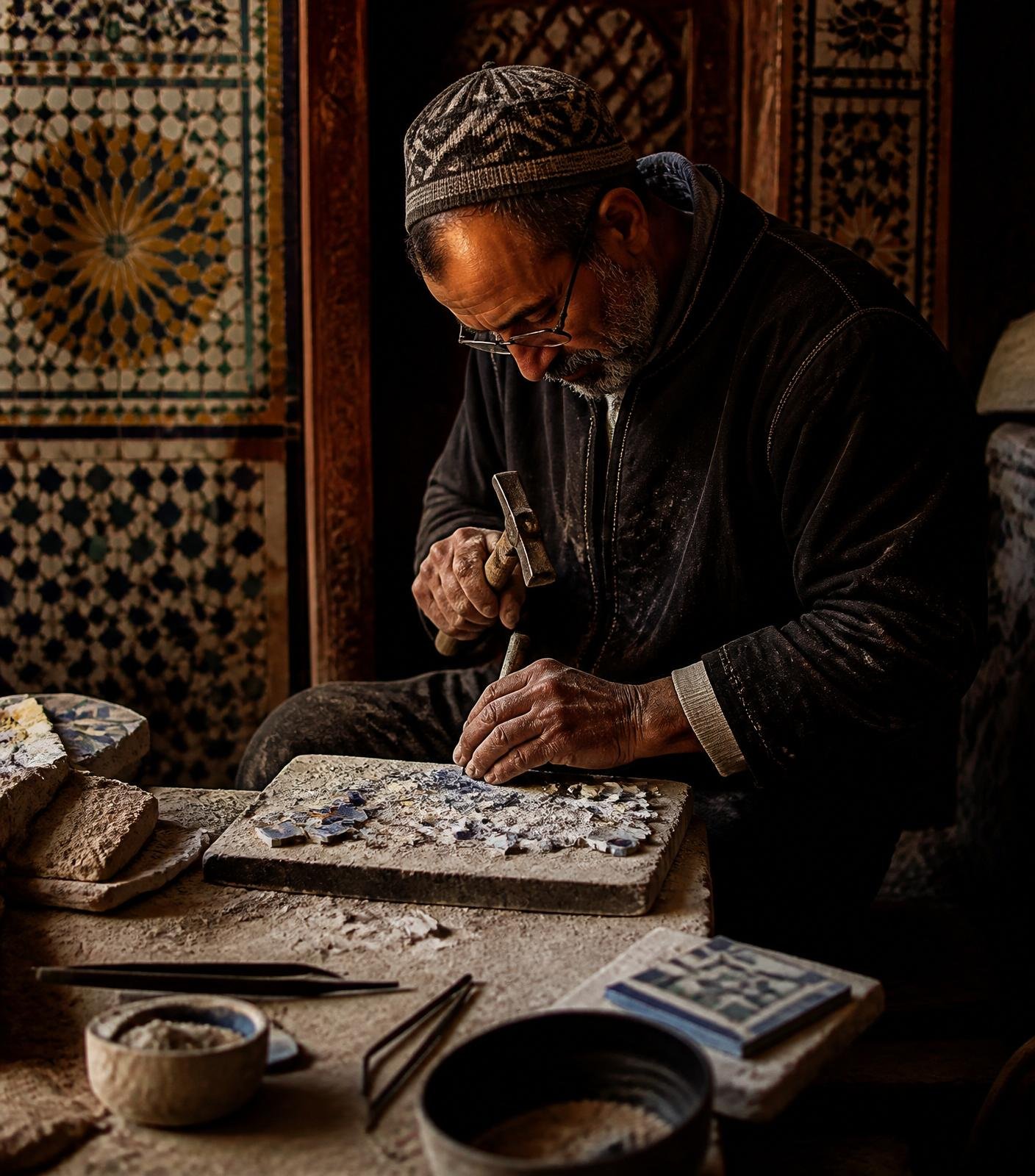
A family atelier in Fez, a craft older than the country's borders, and a stubborn refusal to let a machine touch the clay.

Our grandfather opened a workshop in the Fez medina in 1974 with two kilns and four apprentices. Today the same family runs thirty-one artisans in the same quarter, working from the same clay pits.
We export to architects, designers and hotel groups in thirty-eight countries — but nothing about how the tile is made has changed. It is still cut face-down with a menqach, still fired with olive wood, still sorted by eye.
Grey Fez clay is dug, sieved, kneaded by foot and rested for four days until it holds an edge.
Each tile is hand-shaped in a wooden mould and sun-dried on the atelier roof.
Fired at 900°C in an olive-wood kiln for around twelve hours.
Dipped by hand in mineral oxide glaze — copper for emerald, cobalt for blue — then fired again.
Cut face-down with a menqach into bejmat, scale or mosaic shapes. Millimetre work, entirely by eye.
Dry-laid, photographed, sorted for tone and crated with insurance for the journey.